Atelier as Intimacy: Miro Sabo and Martina Rosenberg Smira in Prague
With over four decades in the fashion and travel industries, Lupe Castro has seen the rise and fall of countless seasons across Paris, Milan, and London. But what she discovered last week at Mercedes-Benz Prague Fashion Week (MBPFW) FW26 was something entirely unexpected: the most refreshing three days she’s spent at a fashion week in years.
Free from the noise of performing presence and front-row politics, Prague delivered pure craft, intimate access, and genuine creative dialogue. Below, Lupe breaks down why Central Europe’s design scene might just be holding the most radical vision in European fashion today.
Below, Lupe spotlights the opening highlight of the Mercedes-Benz Prague Fashion Week (MBPFW) FW26: an intimate look at the seamless, cross-disciplinary collaboration between jewelry maker Miro Sabo and fashion designer Martina Rosenberg.
On the first day of MBPFW, supported by ELLE Magazine Prague, Miro Sabo presented his latest work at SoSaZu Club, outside the main show venue.
The setting immediately shifted the context—more intimate, more contained, and distinct from the main runway schedule.
The runway resisted immediacy. Pieces moved through low light, partially revealed, withholding the clarity that fashion shows typically rely on. The effect created distance—but also curiosity.
That distance led to the conversation that followed.
Seen up close, in the atelier, the collection revealed a different reality: precision, structure, and a level of construction that could not be perceived on the runway.
One moment stood out. Among the models, Sabo invited another designer to wear his work—a gesture that quietly challenges the competitive framework of the industry.
“We share the same problems,” he explains. “On one level, we are competitors. But at the same time, we support each other.”
This reflects a broader understanding of fashion as a shared system. Designers, clients, and collaborators operate within an ecosystem rather than in isolation. A garment is not a singular purchase, but part of a growing wardrobe.
Clients move between designers. They build, rather than commit. Fashion becomes cumulative.
What appears simple is rarely so. A draped dress conceals precise construction.
A minimal piece of jewelry may be the most technically demanding object in the room. The tension between simplicity and labour defines Sabo’s work.
This approach is rooted in a specific history.
In former Czechoslovakia, fashion houses operated through highly structured systems aligned with
French couture traditions. Modelists, cutters, and seamstresses worked within clearly defined roles, producing garments through discipline and technical precision.
After the Second World War, these maisons were absorbed into state-run structures. While names and clientele changed, the systems of making remained intact.
By the early 1990s, this system collapsed. What endured was the knowledge carried by its makers.
Sabo’s atelier is built on that continuity.
The women who work with him today come directly from this lineage. He has assembled a team of master makers whose expertise lies in method rather than speed.
Lining is set by hand. Structure is built, not assembled. The difference is visible in how a garment holds.
Authorship here is shared. The designer defines the direction; the makers interpret with precision.
The result is collective rather than singular.
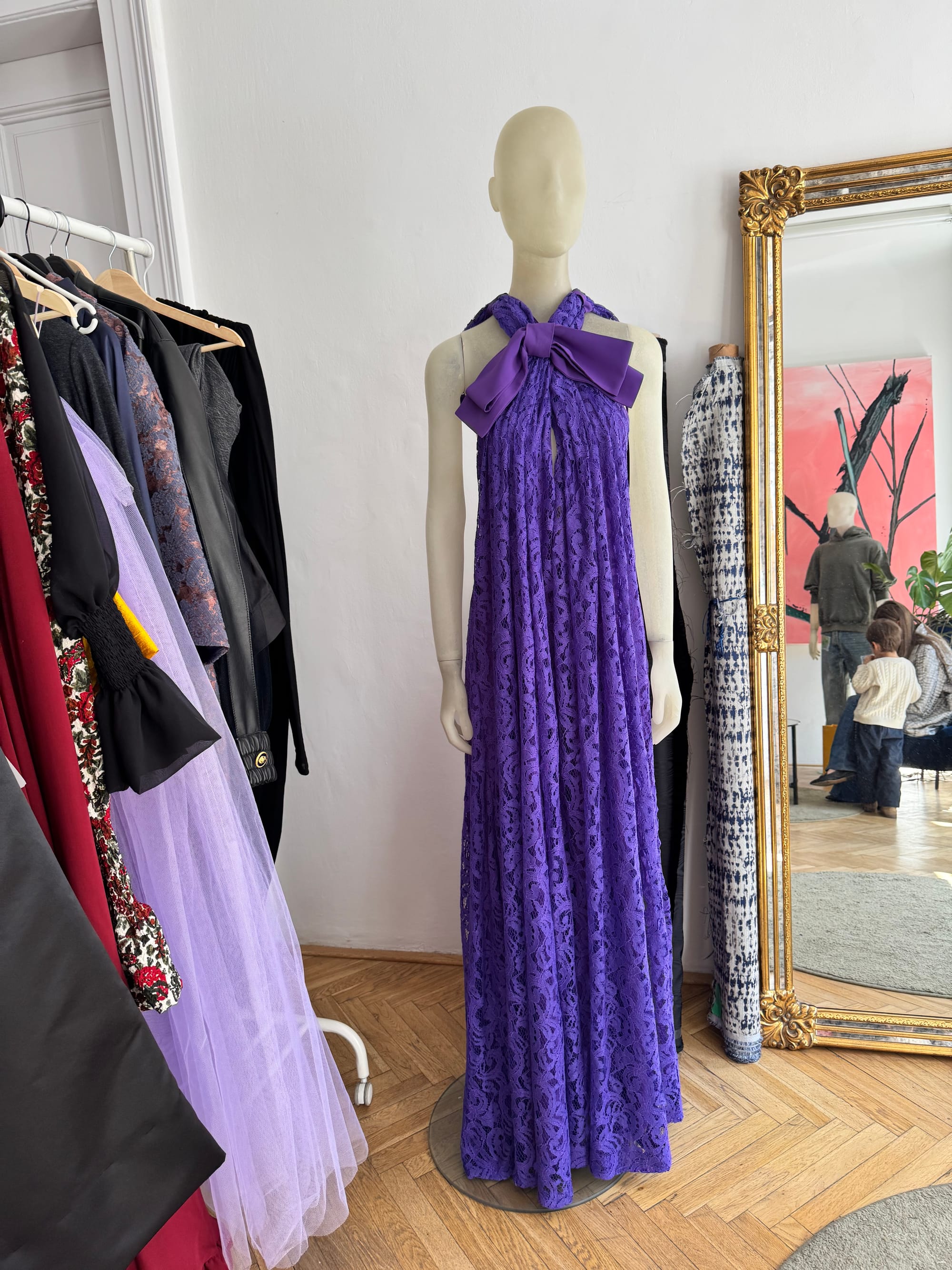
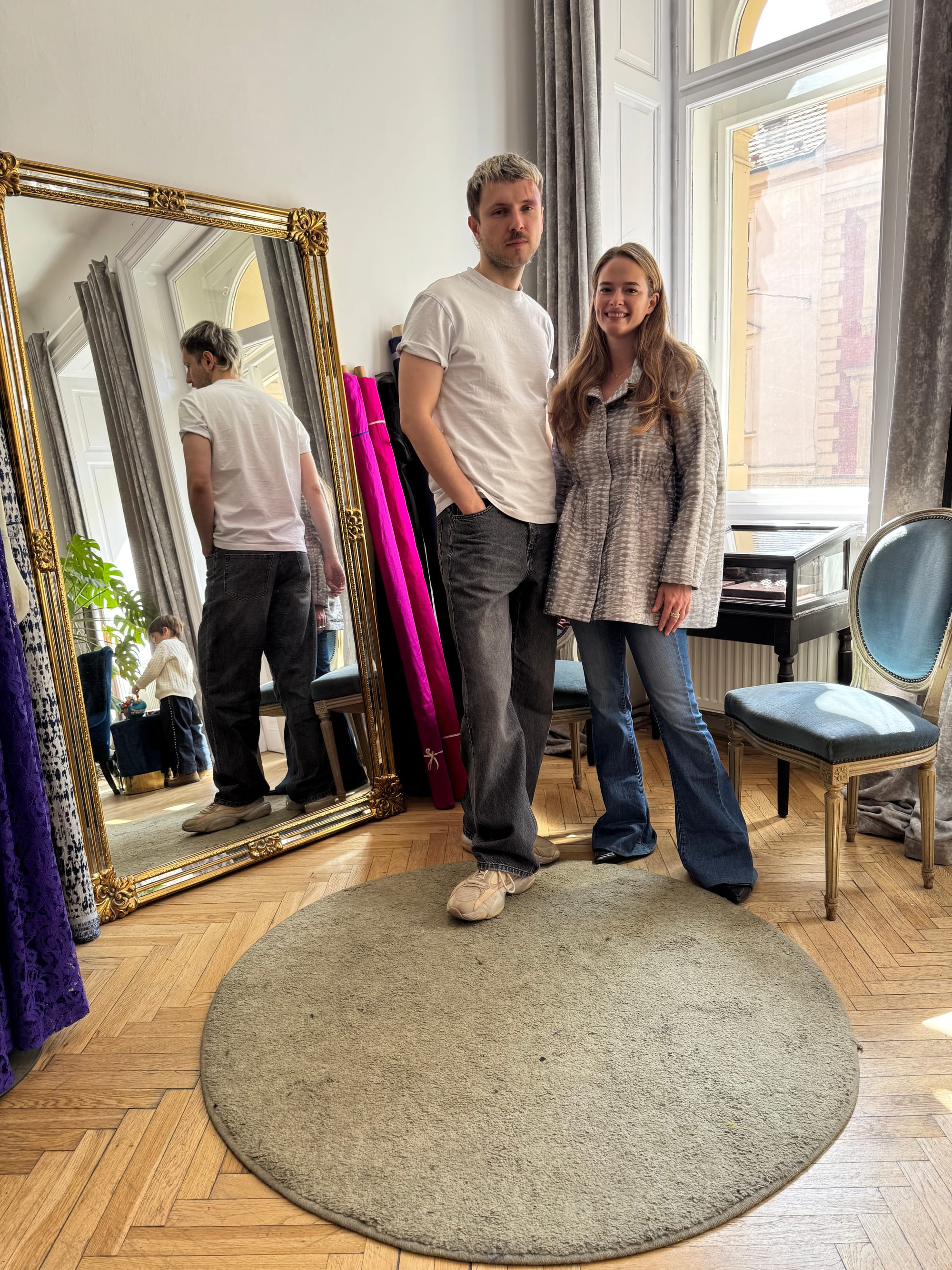
Within this context, Martina Rosenberg Smira enters the dialogue.
Having known Sabo for over a decade, their collaboration is intuitive. Her work, informed by historical references such as medieval bracteate coins, introduces material and symbolic depth.
Her move into fine jewelry—working with gold and diamonds—responds to the presence of Sabo’s garments.
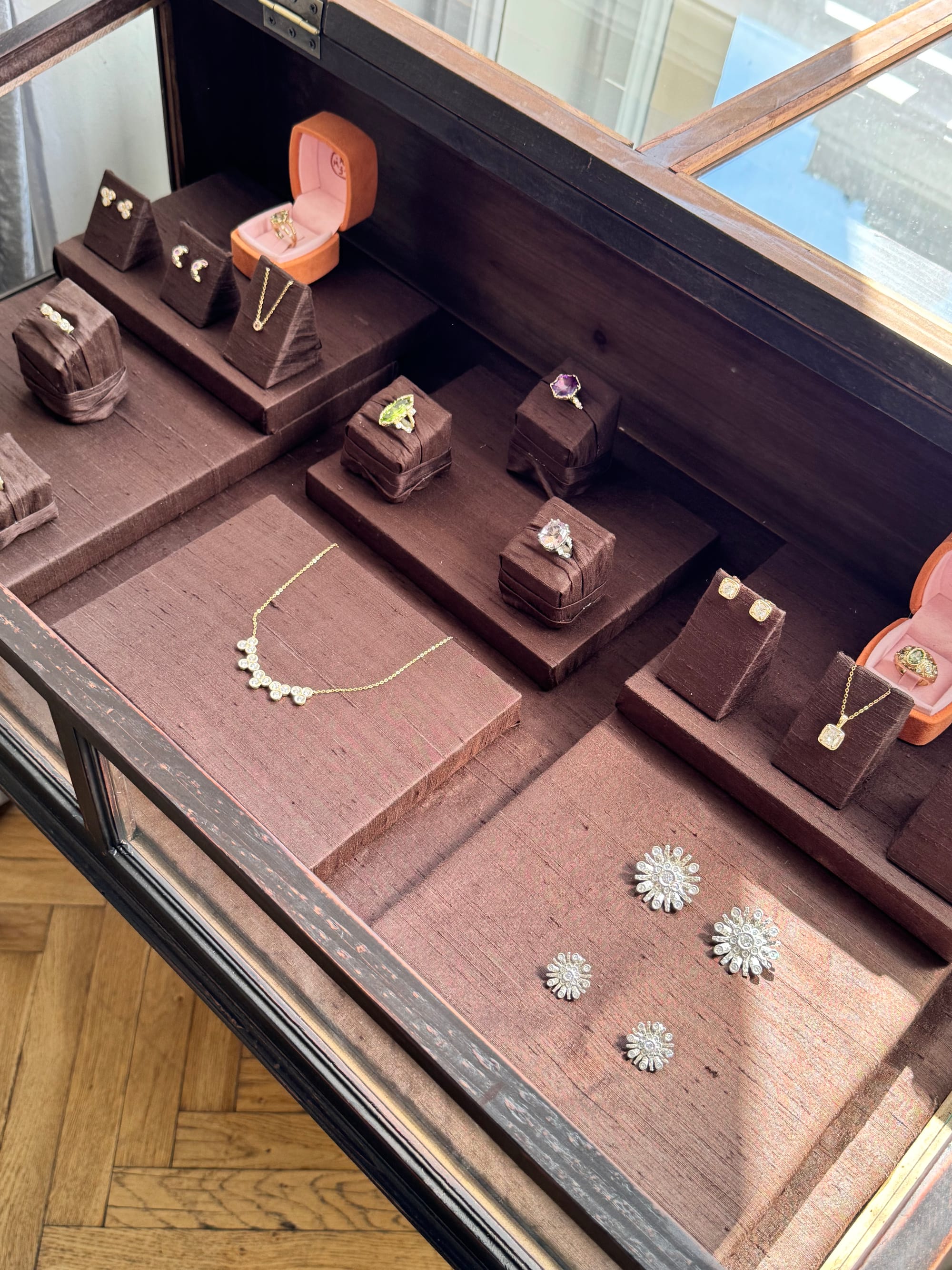
Jewelry does not decorate. It completes.
Together, their practices form a balanced exchange.
Beyond the atelier, a broader shift emerges. In a landscape shaped by digital immediacy, there is a renewed interest in physical experience—clients seeking to touch, try, and understand.
Fittings become conversations. Garments become relationships.
Sabo’s work proposes a different rhythm: from immediacy to duration, from image to presence, from consumption to connection.
This approach extends to presentation.
A pop-up space runs until the end of April, offering direct engagement with the collection.
Rosenberg Smira works with lab-grown diamonds and freshwater pearls, set in gold and silver—maintaining craftsmanship while recalibrating access.
Her independent jewelry line continues alongside the collaboration, with growing international presence, including representation in Japan.
Sabo is also expanding online, extending the atelier beyond its physical space.
The collection is available in Prague and online—though its full dimension is best understood in person, where material, construction, and presence align.
Texts and Photos by Lupe Castro @mslupecastro